
University of Chicago Laboratory Schools
Chicago, IL
Lead Teacher
Gerard Gueringer
UChicago Laboratory Schools’ Fall 2025 Music Club (Grades 1–2)
— Overture Games•Lead Teacher: Gerard Gueringer
University of Chicago Laboratory Schools B
The Class That Wouldn’t Stop Asking for Rocket Race
UChicago Laboratory Schools · Fall 2025 Overture Games (Grades 1–2)
Lead Teacher: Gerard Gueringer
On the first day of the fall session, Gerard Gueringer walked into UChicago Lab carrying a familiar mix of excitement and uncertainty.
Students were excited and engaged to learn about rhythm in multiple different ways,” he wrote that afternoon. There were hiccups connecting devices to Wi-Fi, but the room stayed focused. They talked about what music meant to them. They clapped rhythms. They played Rhythm Rally together.
It was clear right away that this group brought energy. A lot of it.
Early Energy, Big Feelings
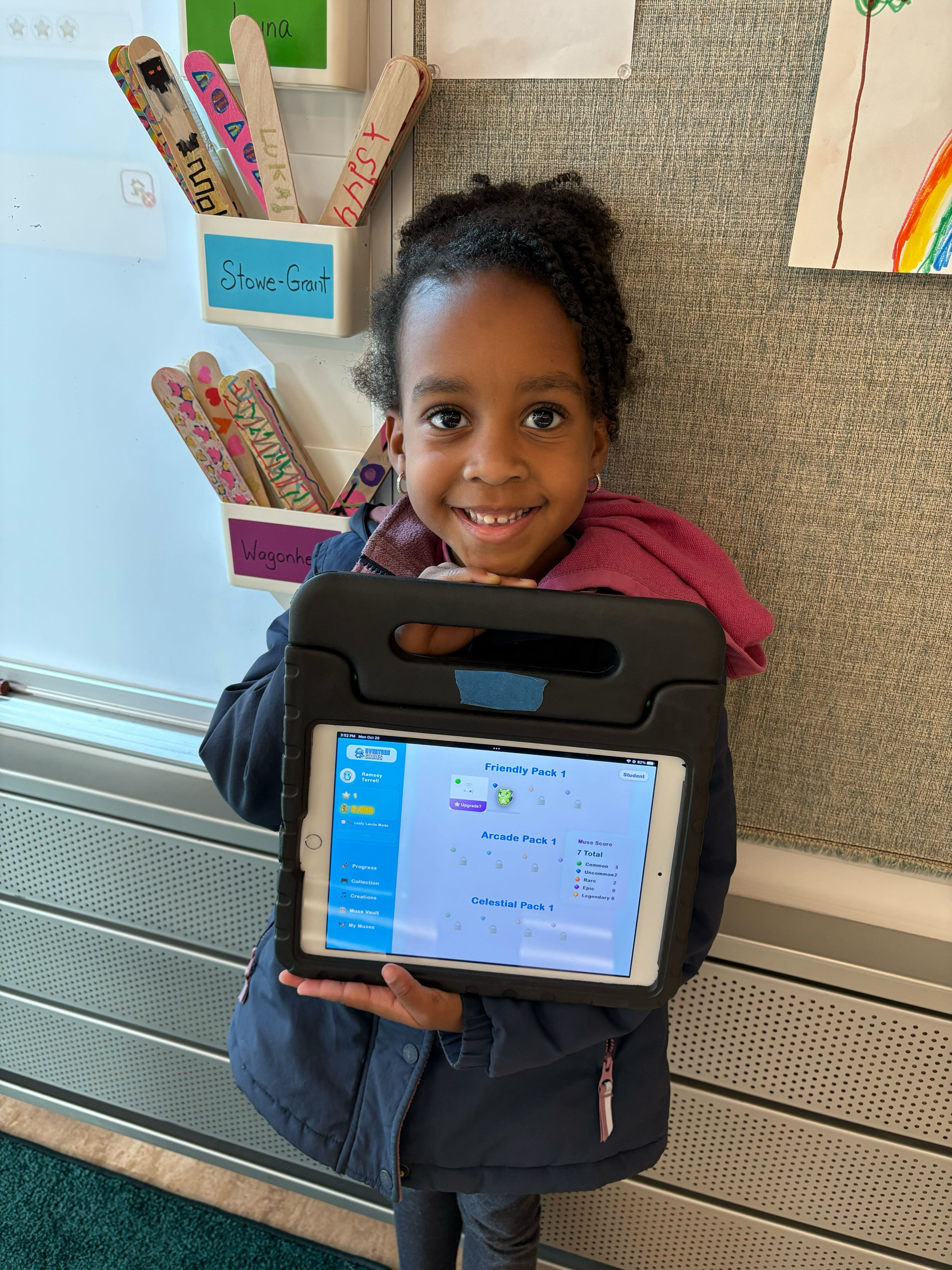
By the second and third weeks, the pattern was taking shape. These students loved moving fast. They loved games. They loved being called up to answer questions. Rocket Race quickly became a favorite.
Rocket race went really well,” Gerard noted. He started using it as a routine. Students discussed answers together, then sent up one person to give the final response. Major versus minor. Instruments. Patterns.
Some students finished levels quickly and asked what else they could play. Others needed more help reading reflections or navigating the progress map.
I had to individually go through the reflections with each student,” Gerard wrote. “Most of this class was learning to read and how to comprehend the questions being asked.
So he adjusted. More group activities. Clearer transitions. Less waiting.
Finding the Right Rhythm
One afternoon stood out.
Today was a very high point for student enthusiasm,” Gerard wrote after the September 29 class. “I had students telling me they were looking forward to coming to class all week.
There were still technical snags. Harmonidome took a restart. Piano Clicker did not land the way he hoped. The kids asked for other games they had unlocked.
But the feeling in the room mattered. The students were eager. They wanted to play. They wanted to answer. They wanted to keep going.
Later that fall, Gerard noticed something important about this age group.
A lot of the activities worked really well when we did them as a group,” he reflected. “I’m assuming this is because of the age group but also the ability to optimize the transition from focusing on the teacher to their devices.
So group play became the anchor. Students came up one at a time. They guessed instruments. They controlled sound together. They watched, waited, and cheered for one another.
When Things Got Rowdy
Not every class felt smooth.
Today was a bit on the rougher side,” Gerard admitted after one high-energy afternoon. “I wasn’t ready for my students to be so energetic today which turned into impatience.
There were delays. Tuna did not respond on the iPad microphones. A few students tested boundaries.
Still, when the games stalled, the music did not. The class shifted into melody creation using Melopedes, Overture Music Lab, and Incredibox.
Students were able to create their own melodies,” Gerard wrote. Some needed extra demonstration. Others jumped straight in.
Even on the harder days, students stayed engaged once they were building something.
A Turning Point
By late October, things clicked.
Today went really well,” Gerard wrote after a class he rated a 9.5 out of 10. “It was great to see students get better at the games as they played and then translate that to musical knowledge.
They rotated between Melody Shaper and Skip Step Repeat. They moved on to Melopedes and composition tools. At the end of class, the students had one request.
This class loved Rocket Race,” Gerard wrote. “At the end they asked if they could play me for a prize.
He said yes.
Ending on a High Note
The final class arrived faster than expected.
I realized this was our last class this morning,” Gerard wrote.
The lesson focused on dynamics. Loud and soft. How music changes. Students played Name the Instrument on Rocket Race, then practiced terms together.
They loved Flappy Muse,” he wrote. Each student came up to play for two turns while the rest watched.
The game could not be unlocked on their devices (because a microphone based game is tough with 10 students making noise concurrently), and they were disappointed. So they played it as a class. They practiced dynamics rainfall. They talked it through.
At the end, they sat together and reflected.
We finished class off with a group reflection about how the program was for them, their favorite moments and favorite games,” Gerard wrote.
There were no keychains that day. Instead, Gerard handed out candy at dismissal. (He later gave Overture keychains to the afterschool director to make sure they got to students!)
The students still asked questions.
They wanted to know if they would keep access to their games. They asked if they could keep playing with their parent accounts. They wanted to know what came next.
What Parents Saw Over the Fall
Across the fall session, this group learned rhythm, melody, harmony, form, and dynamics. They learned how to listen closely. They learned how to wait their turn. They learned how to play together.
They also learned that music class was a place where their energy belonged.
As Gerard summed it up after the final session, “Today was a great class.”
For a group of first and second graders who spent the semester clapping, guessing, singing, composing, and asking for Rocket Race one more time, that feels exactly right.