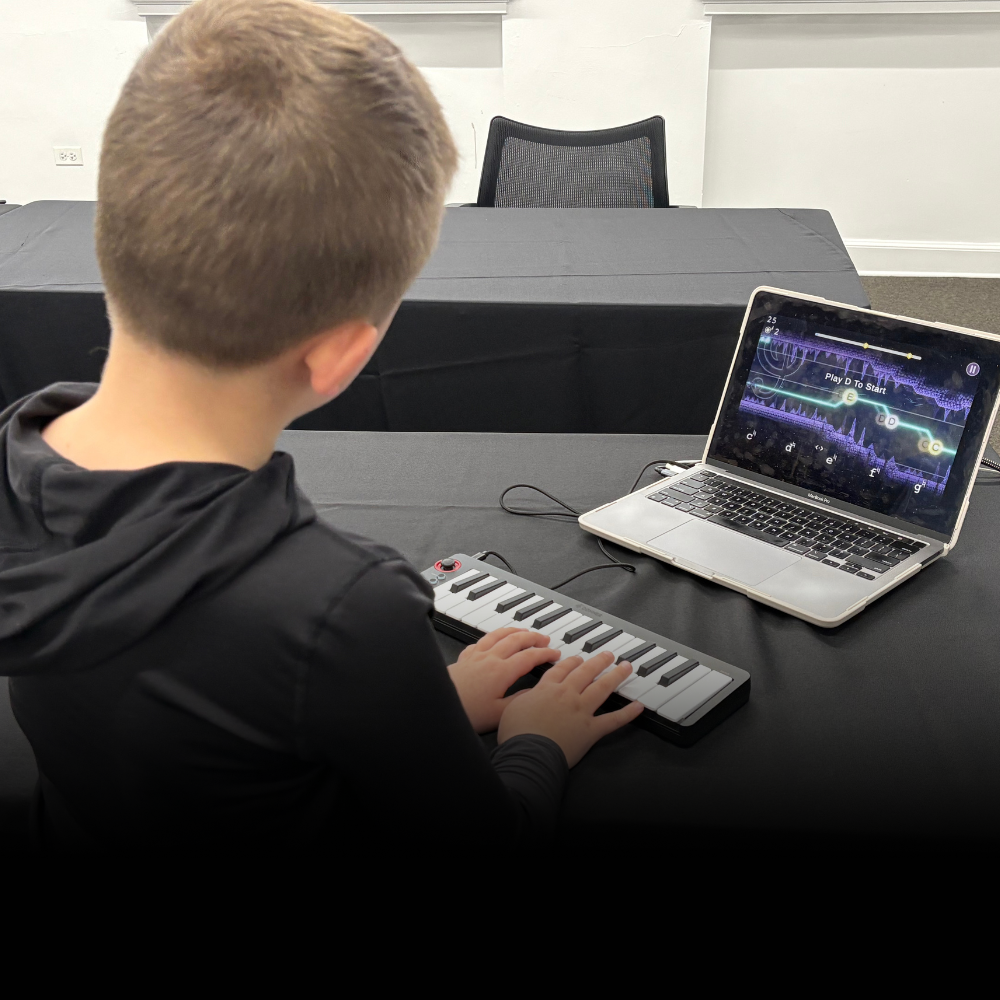


British International School Tuesday’s Fall 2025 Music Club
— Overture Games•Lead Teacher: Alex Klausner
When Miles Threw in 7th Chords
British International School Tuesday · Fall 2025 Overture Club
Lead Teacher: Alex Klausner
Week Two: The Rhythm That Made Dad Proud
Second week of class. They were working through Beat Decoders, a game where you identify and create rhythm patterns.
This group was sharp. They got through the activities quickly, understanding concepts faster than expected.
Then Miles created something.
He worked on a rhythm, tweaking it, adjusting the pattern until it felt right. When he finished, he didn't just save it and move on.
He showed his dad at pickup.
"Miles came up with a rhythm and felt proud enough of it to show dad!" Alex wrote.
That's the moment that matters. Not just making something, but being proud enough of what you made to share it with someone who matters to you.
Week Seven: The Beethoven Teaching Moment
Musical form week. Learning about ABA structure—how songs have sections that repeat and change.
The energy was low that day. Kids came in tired, a couple were late. And on top of that WIFI was buggy. Playback wasn't working correctly for some students.
Alex could have skipped composition entirely. Stuck to easier activities. Waited for the tech to work.
Instead, he turned the bug into a teaching moment.
"I use it as an opportunity to teach them about Beethoven!" he wrote.
Beethoven, who composed some of his greatest works after going deaf. Who couldn't hear the playback either but kept composing anyway.
The kids created songs in ABA form that day, even without being able to hear what they were making until the very end when the tech started working. Music theory took the forefront in this class and kids got to see how patterns and theory can help guide great sounding music.
Sometimes the obstacles become the lesson.
Week Twelve: The Final Composition Project
Last week of the semester. Alex gave them a challenge: create a final composition that meets four specific criteria.
Lucas immediately gave him the "Well, I already know this stuff" attitude. Which, to be fair, Lucas did know the musical concepts they'd been teaching.
Alex didn't back down.
"Okay, great, so you're going to be able to give me a final composition that meets my 4 criteria?"
Lucas got the picture. He participated, even gave a good explanation of chords during the lecture.
Then the kids started composing. At first, they tried the bare minimum. The fastest path to "done."
Alex held the line. He wouldn't accept anything less than meeting ALL the criteria.
That's when it got interesting.
"They worked with me and asked for help composing certain elements, which gave me opportunities to teach things like 'Try starting your melody on a note that's in your triad,'" Alex wrote.
And then Miles did something unexpected.
He threw a bunch of 7th chords into his composition.
Not basic triads. Not simple major and minor chords. 7th chords—more complex harmonies that add color and tension to music.
"Especially impressed with how Miles threw a bunch of 7th chords into his work," Alex noted.
By the end of class, every single kid had completed a final composition. Original music that met all four criteria.
"So many of the kids had really interesting and creative ideas, especially when it came to their approaches to rhythm," Alex wrote.
And here's the key detail: "The kids were pleased with their compositions."
Not just done. Pleased. Proud of what they'd made.
What They Actually Created
Over twelve weeks, this group went from clapping rhythms on a board to composing multi-element songs with 7th chords.
They learned to identify major and minor harmonies so well that Alex noted they were "really sharp" at it. They crushed hard mode on instrument identification in Rocket Race. They composed melodies using steps and skips. They built songs in ABA form.
But the real story is in those final compositions.
Kids who initially tried to do the bare minimum ended up asking for help to make their music better. They wanted their melodies to start on notes that fit their chords. They experimented with complex rhythms. Miles added 7th chords because he wanted his composition to sound more sophisticated.
"The kids were pleased with their compositions," Alex wrote.
That's different from "the kids finished their compositions." Pleased means they listened back and thought, "Yeah, that sounds good. I made that."